Ward Family House Diary w/added pictures
Sections of original diary with titles intact
Header
The letterhead was:
George D. Ward & Associates
4941 S.W. 26th Dr., Portland, Oregon 97201
(503) 293-6075
Environmental Consulting Services
What
Background information concerning historical and unique characteristics
of this old house located at the address noted above.
Prompted by podding by members of the Ward family and friends, the
following memories were summarized for those who might have some
interest in various things that have taken place in this old place
during the past 49 years while the Ward family lived there.
George D. Ward.
May 6, 2003
When
It is believed that construction of this house may have started
during WW II in late 1943 and completed in 1944.
The house and property were purchased by the Ward family in early 1954.
It was previously owned by Mr. & Mrs. Steston. At the time of purchase
the entire house inside and out was painted blue.
How Much
The purchase price was $12,500 plus an additional $500 charge to
disconnect the septic tank and drainfield and connect to the new sewer.
The original septic tank was discovered during excavation for the master
bedroom. The city building inspector insisted that it be removed but the
family refused by convincing him that we intended to convert it into a
wine cellar. It is still there! Just waiting.
Original House Size
The house originally had only two bedrooms. The basement was unfinished
except for old "concrete wash tubs" that are now buried somewhere in the
backyard. Included was only one small bathroom.
What Did The House Look Like Originally?
The closest example is the small, grey color house to the east on the
north side of S.W. Mitchell. It is the third house east on Mitchell,
but its floor plane is upside down from this old house.
Our front
entrance was once located the same as the grey house's present
entrance.
Property Contours
There is no similarity what-so-ever between the property's present
contours and those of the original property.
The Ward's love to dig.
Every square foot of the original 15,000 has been changed with the
exception of the driveway and about a two foot patch of soil between
the two surviving fir trees next to the log cabin window.
Trees
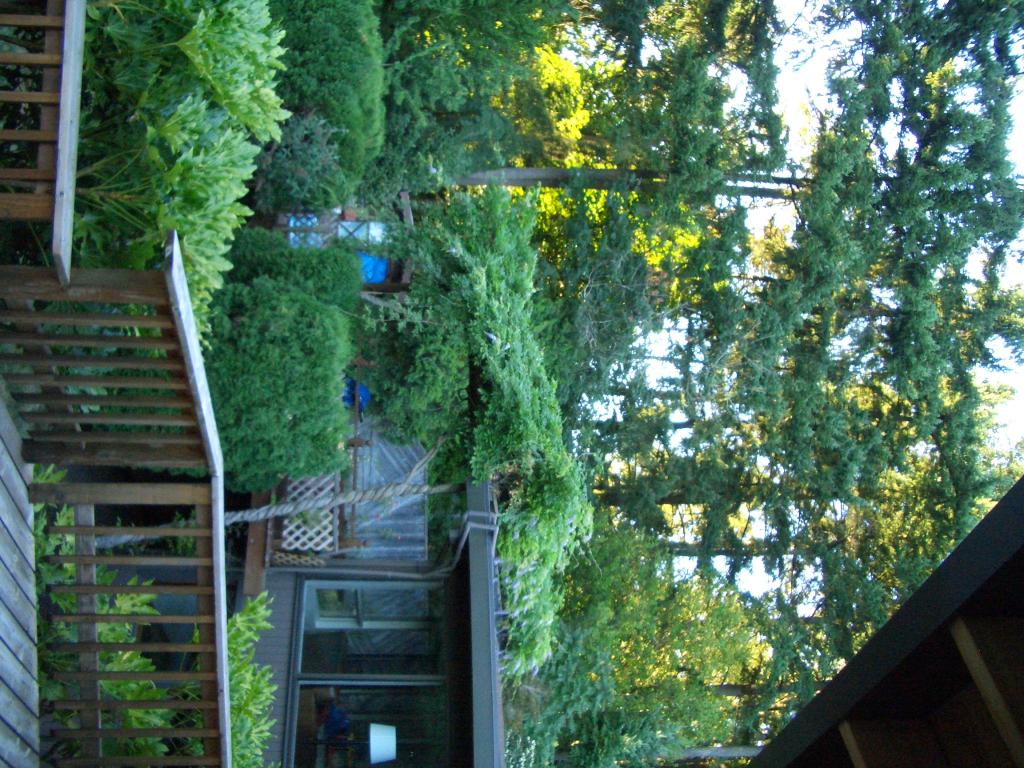
Over time several large fir trees have been blown down. The columbus
day storm in about 1963 took out the most.
Prior to the development of the Campbell estate property there were
no fences leaving the backyard open to a large wooded area planted
many years ago by Col. Dosch. Many spcimen (what/sp?) trees were
there and the Campbell house was the only house on the estate
property.
In the early 60's a 600 lb. Elk came onto the Ward property from the
creek and left giant footprints and "muffins" all over the place.
Local authorities thought the beast might be dangerous and had it shot
at about where the steps are now for the pool deck. Bummer - the Ward
kids wanted to keep him as a pet - all 600 pounds.
First Major Addition
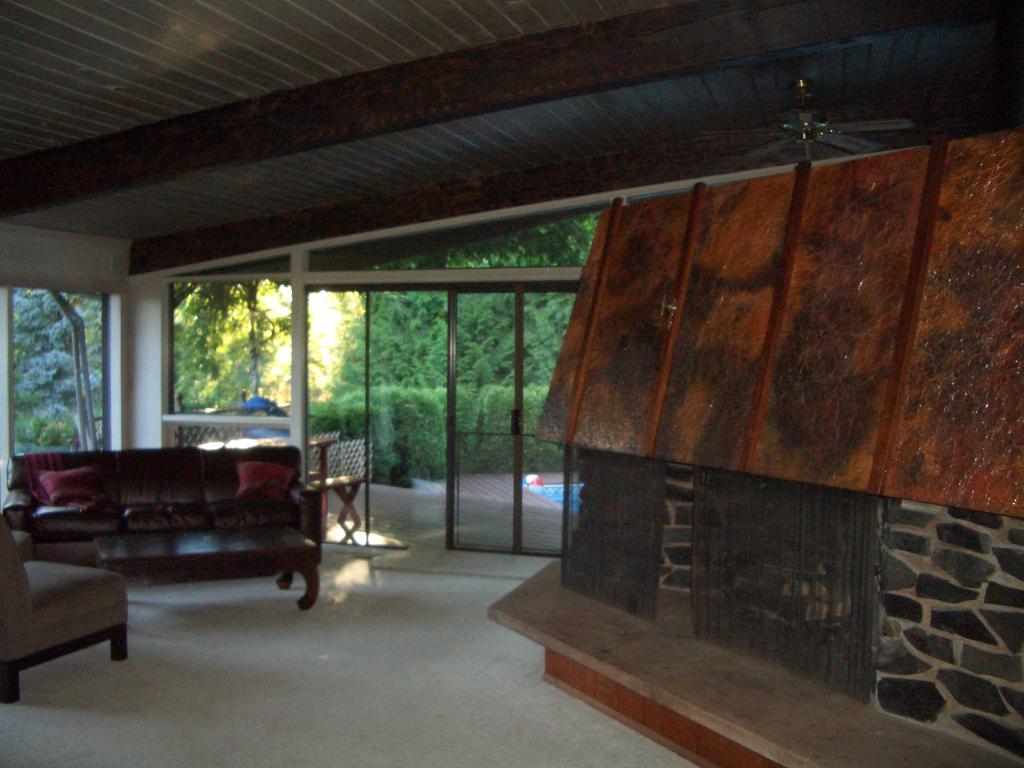
The living room and daylite basement was the first project. The
original garage was torn down by the Ward kids. Only the original
concrete garage floor was saved and is now part of the carport floor
(more on this later).
- 1) Before the new living room was carpeted the Ward kids and
neighborhood kids used it as a skating rink on special occasions.
- 2) The new living room roof was used for solar heat experiments
as a means of heating the swimming pool. At one time as many as 20
solar test areas were occupied by a variety of solar demonstration
zones. One zone is recognized as having the first solar meltdown
anywhere in the Pacific Northwest. (This is the truth)
- 3) A toned down solar heater is still in service over the living
room. It still works.
- 4) The living room roof also served as a jump-off point
for the teenagers from all over the neighborhood who wanted to enter
the pool from the sky. All made it!
- 5) The Living Room Fireplace
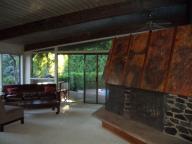
Isn't your ordinary fireplace. The basalt rock backwall is made
from Columbia River basalt known to be several million years old.
It was hand picked by George Ward and then stolen by him from an
abandoned tock quarry along the Columbia Highway a few miles east
of Corbet.
The copper hood above the fireplace was hand sculptured using a
cadillac with snow tires and running over copper flashing material
that was laid out on the gravel driveway. The badly abused copper
was then thrown in the fireplace and burned in order to get the
tarpaper off the backside of the rolled copper sheeting. The
dark color on the copper hood is the result of the fire. As such,
no two sheets are the same and yet the pattern of color between
each panel matches the pattern of both adjacent side sheets.
Remarkable but true!
Behind the hood is a large metal box that hold about half a ton of
cobblestones scrounged from an old street car line on north Albina
ave. The cobblestones serve as a giant "heat sink" that continues
to give off heat for many hours after the fire is out. The purpose
of the overhead paddle fan is to distribute the residual heat.
Below the concrete floor of the fireplace there is about a 2 ft.
high crawlspace formed between the wood floor support system of
the living room and the original concrete garage floor that is
about 6" thick - solid concrete! There is the remains of a
secret tunnel below dug by the Ward kids and neighborhood
kinds by hand many years ago. The construction of the tunnel was
the kids' idea and it was done secretly by the kids who had watched
the movie The Great Escape in which Steve McQueen and others
escaped from a German prisoner of war camp during WW II. We even
found an old suitcase at the tunnel's entrance as was done during
numerous WW II real escapes. The entrance to the tunnel which heads
westward toward the swimming pool was sealed with concrete about
40 years later. Portions of the tunnel which was dug through the
hard clay still remain and include treasure items tossed in for
future kids to wonder about. The tunnel is very cramped but
structurally safe. The treature items remaining in the tunnel
are also safe but will remain secret for some other family's kids.
It's a good way to keep your kids off the street!
The Master Bedroom Wing Was The Second
Major Addition
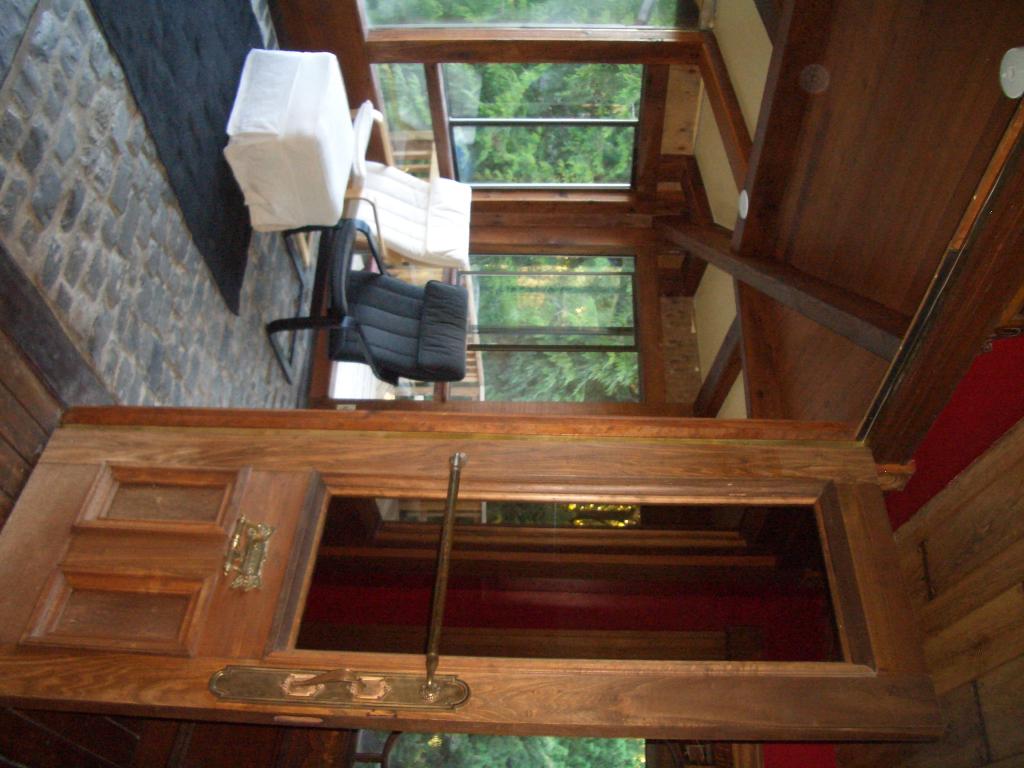
Included along with the bedroom is the sunroom with it's cobblestone
floor, the two story, open atrium, the sauna, the old fashion bathroom
and the redwood hot tub.
Practically none of the above was included in the original plans. As
construction proceeded we kept finding all sorts of unique doors and
windows, old wood trim, tin ceiling material and especially the huge
floor beams that Jeff Ward recovered from an old abandoned railroad
bridge in Milwaukie. The beams were too long for the plans but they
were too unique to shorten so we kept the full lengths and redesigned
the whole addition in order to accomodate the full length of the beams.
All the plans had to be changed and the permit required that we file
an appeal - just to save some old railroad beams. We still think it
was the right thing to do even though it ran the cost of the project
substantially over budget.
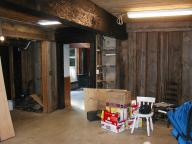
Included in the south wing addition are the following items that are
not usually found in today's modern homes. This is because we wanted
it that way. Included are:
- Sauna Door: Thick wood sauna door was found hanging in
the rafters of an old second hand store in S.E. Portland. It was
originally used on a refrigerated storage room as indicated on the
metal name plate.
- The Solid Brass Frame around the sauna heater came from
England. It was used originally as part of a coal burning fireplace.
It was found in a junk store - it's solid brass.
- Cobblestone Sunroom Floor: The cobblestones used in the
floor (and in the living room fireplace) were salvaged from the south
bank of the Columbia slough. They were dumped there illegally by a
Portland contractor who was hired to remove an old streetcar roadbed
on north Albina. He allowed me to "recover" the cobblestones in
exchange for my getting him out of trouble with the authorities.
The cobblestones are set in a bed of sand contained in a heavy duty
membrane liner. Copper heating coils were buried in the sand but
were never hooked up to either the roof solar heater or the
wood stove.
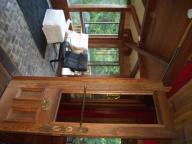
- Porcelin Room Numbers: These were scrounged from a second
hand store in north Portland. They reportedly came from an old
Portland hotel. They code $0.25 each including the "solid gold"
lettering.
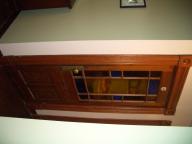
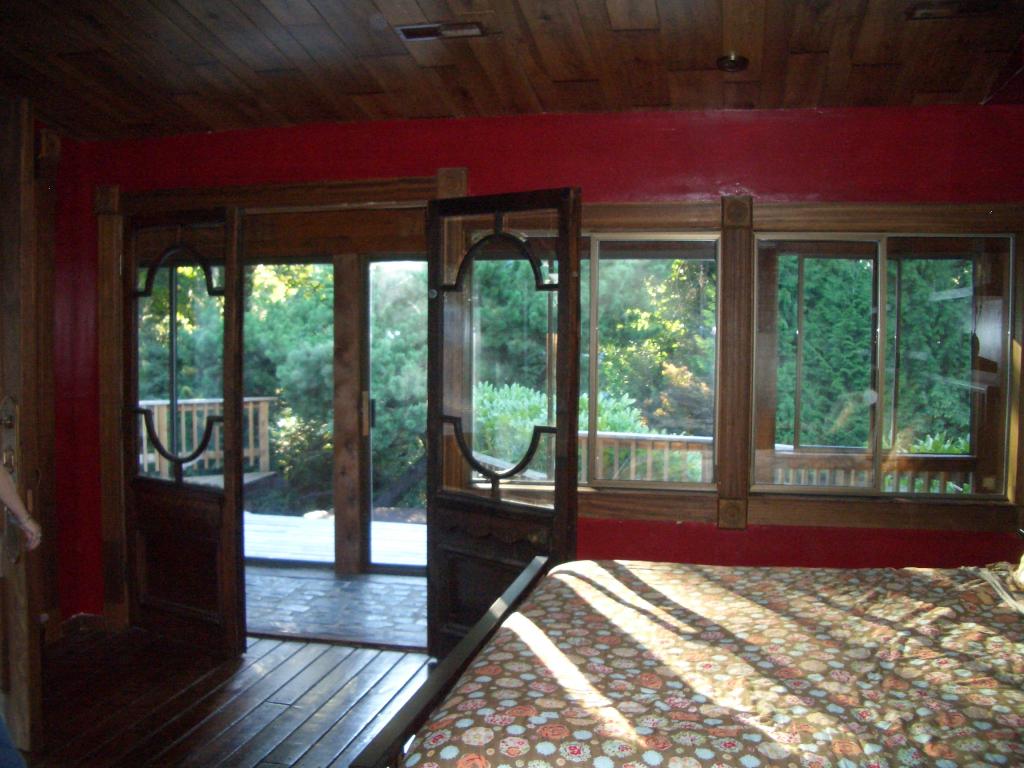
- Large Sunroom Doors: These were found in an old warehouse
near the waterfront in east Portland between union ave. and the
railroad tracks. They reportedly came from an old office building.
Note that none of them match but who cares! The brass hardware
was found as pieces and parts from several junk stores.

- Small Sunroom Doors: These were also found in an old
warehouse in the same are described above. They reportedly were
imported from England or France.
- Oak Bedroom Closet Door: It is from an old church in N.E.
Portland according to the hippie I bought it from for $65.
- Fixed Pane Master Bedroom Entrance Door: This door is
identical to others in the house. I found a whole stack of them in
a barn in north Portland and bought the whole bunch for $8 each.
They are believed to be from an old apartment building built in
the 1920's.
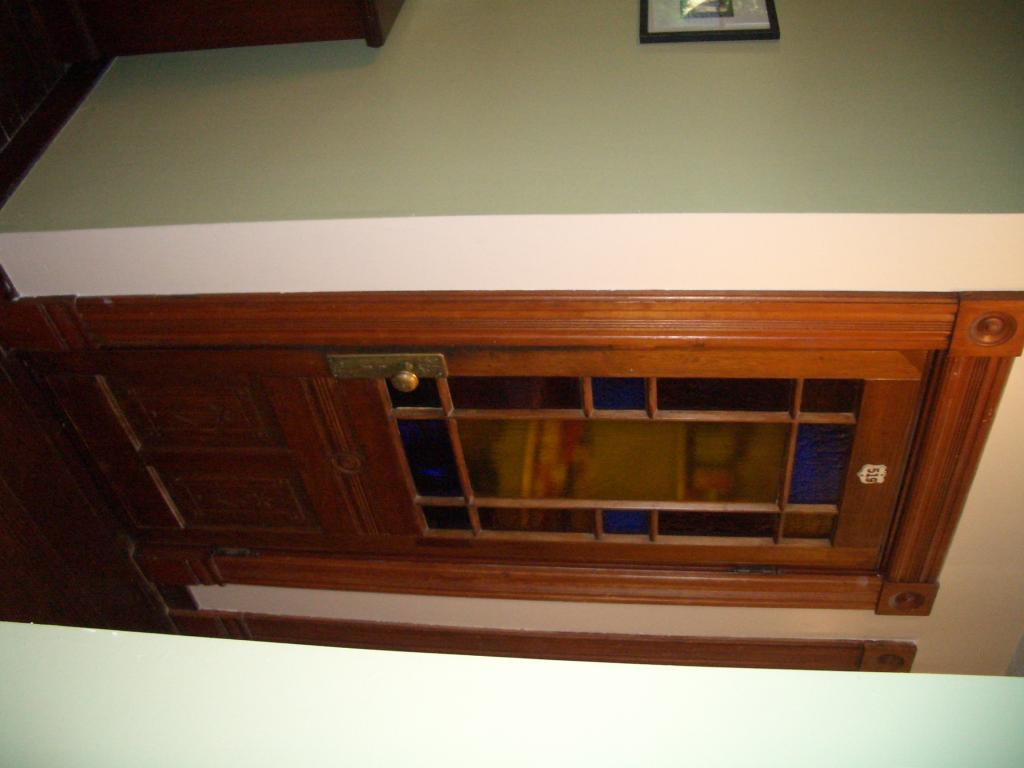
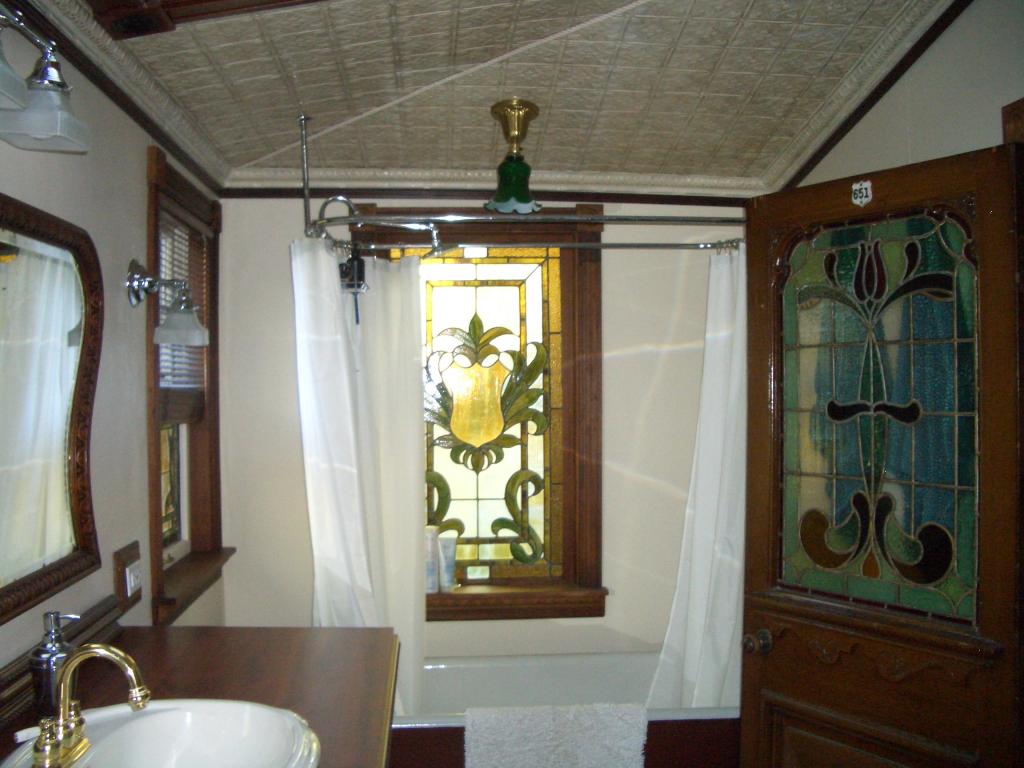
- Master Bedroom Bathroom Door: Thsi door was
imported from England. Note that the wood grain especially on the
lower panel is authentically fake! It is painted on over
what may only be pine or other species that is very light in weight.
Note that one side of the lower panel looks like expensive quarter
sawn oak while the opposite side looks like black walnut. Both sides
are true fakes. So is the rest of the door except for the stained
glass. It's not fake!
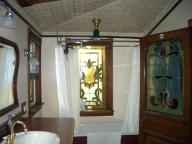
- Master Bathroom Mirror: Also imported from England and
reportedly is quite old as well as very valuable.
- Master Bathroom Wash Basin Cabinet: The top is new but
the cabinet is from an old sideboard reportedly imported from
Europe.
- Pull Chain Toilet: This is the real thing and definitely
is not a replicatin. However, the water tank support brackets did
not come with the original tank fixture. They originally were used
support old concrete washtubs many years ago - before "plastic" was
invented. I had them brass plated because they used to be real
ugly.
- Bathroom Tin Ceiling: Definitely Authentic!
The pattern and the stamps and dies used to press the pattern into
tin sheets date back to the 1800's. I grew up in a Kansas farm
home that had the same type ceiling. I loved it! It also had an
identical pull chain toilet, claw foot tub and stained wood
wainscotting. The problem with today's toilets is that they don't
roar, rumble and shake the house when you flush them, without that
unique sound you've got nothing to remember.
Front Family Room & Hallway
- Wood Ceiling Beams: These came from an old farm
building along the Columbia river highway toward troutdale.
They are necessary and help hold the ceiling up because years ago
I took some walls out that divided the kitchen and small dining
room from the living room. At one time this same area was turned
into a bedroom when all the kids lived at home and before the
basement bedroom was completed.
- Front Living Room Fireplace: This is the original fireplace
but it is not the original face treatment. I took a sledgehammer to
the polished black marble facing because it looked too modern. The
remains are buried behind the used brick facing. The wood beam
mantle was salvaged from an 1800's era waterfront warehouse
downriver from the present freemont bridge. It was there when only
large sailing ships and steam sternwheelers was all there was!
Other old wood beams used in the basement shop and log cabin floor
and door frame came from the same 100 yr. old structure. Photos of
it during the days of steam and sail are in my collection or
available from the Oregon Historical Society.
- Upstairs Hallway Molding And Pantry Door: These were
removed by me from an old abandoned homestead high in the hills
north of the Dalles, OR. But on the Washington side of the
river. The homestead was located on the old stagecoach road from
Dallesport to Goldendale. The ruins are still there.
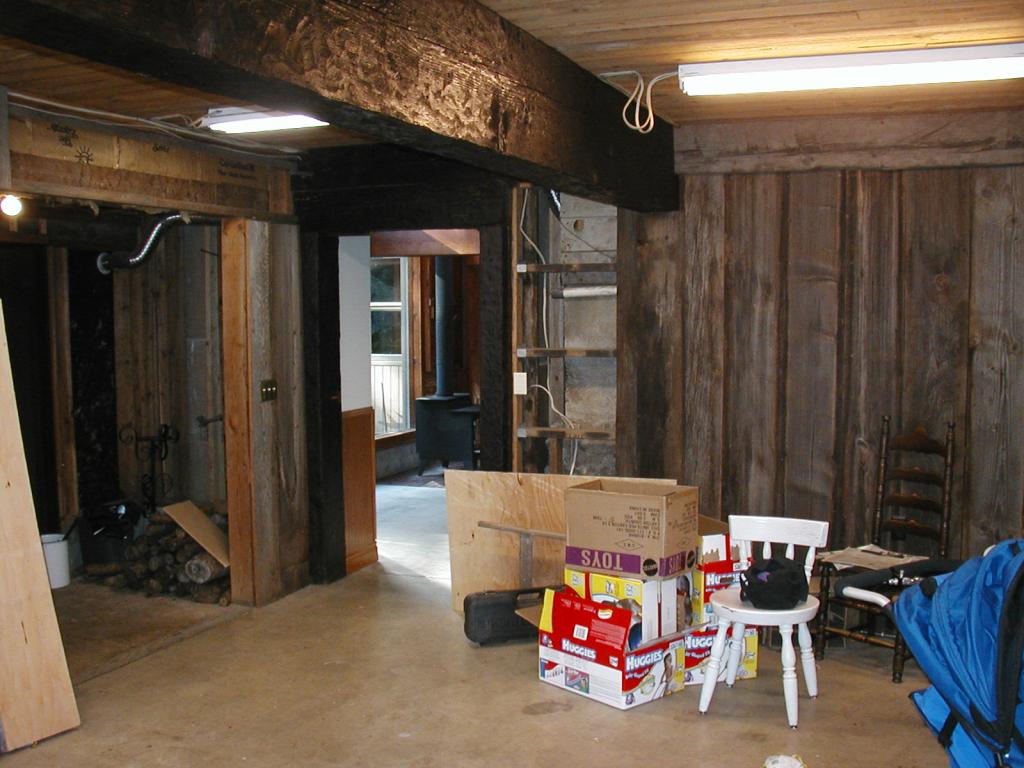
Basement Barnboard
This is authentic and reportedly came from an old homestead near
Shaniko. It dates back to the 1800's when Shaniko was the major
shipping point for wool. Some of the old buildings are still there
but the town died when the railroad stopped serving the area.
Early
history says George Ward was killed in the old Shaniko hotel in the
early 1920's. I'm pretty sure he was somebody else or possibly an
imposter.
Conclusion
I hope you will enjoy this old house as much as the Ward family
did. Take care of it. It's the only one of it's kind anywhere that
I'm familiar with.
erich@uruk.org